

Hijab & Niqab in the Qur'an
The Qur'an is the revelation from the Almighty, the All-Wise, Who created human beings both men and women in His infinite knowledge and might. The Qur'an showed the right path in all matters to generations that went before, as it continues to do to those present today. However, to understand the Qur'an and what Allah expects of us, we must look at the Qur'an itself.
Since the Qur'an is the Book sent down by the creator of human beings, Allah, we logically follow that Allah has laid all His commandments and way of life in the Qur'an compatible with the way He has created human beings and their nature. For example, Allah has made people as male and female to be together and has decreed the system of marriage in religion for them to come together. Or for example, Allah has designed the human tongue with thousands of taste buds, then created fruits of various kinds to be suitable for tasting them using our tongues - he has permitted us to enjoy taste of all the permissible food so long as we show thanks in return. He does not forbid the use of the tongue while having created to perform a feature or he does not forbid men and women to enjoy intimacy having created them in two genders in need of one another.
Allah has created human beings outer appearance to be pleasing to behold. This applies to both men and women. We do not find human beings repulsive. This is so that when we speak with each others as human beings, we find it comfortable to interact. Imagine human beings on earth were created with hideous appearances - this is possible by Allah - undoubtedly, we would find it repulsive to be with one another...difficult to communicate with each other, hold conferences, be friends etc. This is not a matter of good looks, rather a natural human appearance which is inherently pleasant in all humans.
Allah draws mankind's attention to this important fact in His verses as follows:
"(People), do you not see how Allah has made what is in the heavens and the earth useful to you, and has lavished His blessings on you both outwardly and inwardly?" (Qur'an 31:20)
In another verse:
"Children of Adam, take your adornment / pleasantness to every Mosque." (Qur'an 7:31)
Where "Children of Adam" includes both men and women. This humanly pleasantness in everyone Allah speaks of is something for us to thank Allah by and appreciate in all human beings, both men and women.
Over the centuries, in the name of Islam, some of the most concealed ways of dressing has been suggested for 'Muslim' women by clergy, who consist mostly of men. According to them, the "best" way of dressing for a woman involves, in their chosen words, to appear as a black "crow", concealing every part of her including the face, eyes, hands and feet in black drape. In this way, even the simplest shape or form of a human being's appearance is taken away from a woman and she is reduced to a 'mere shadow'.
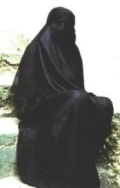
Though different levels of dressing for women was suggested, this is said to be the 'best level' according to them. They also teach that the eyes also be covered with the veil! visible yet in this picture!
Understanding the way Allah created the Human:
The human body is a miraculous act of creation by Allah. Every function of the body is placed through superior wisdom. The human body has five primary senses to interact with the world. These are:
1) Vision 2) Hearing 3) Smell 4) Taste 5) Touch
Each of these senses have
unique sensing devices that are especially designed to accomplish their
respective sensing functions. Sense of touch is done by the skin on
every part of our bodies. The sensors for vision, hearing, smell and taste are
all concentrated on one particular place, the human head.
This is for an important reason. The reason being solely the fact that
the head is intended by Allah to be exposed to the environment.
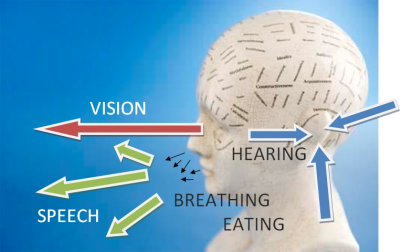
All organs that requires to be fully exposed to the environment are strategically placed on the head so that it can work at its best performance without hindrance.
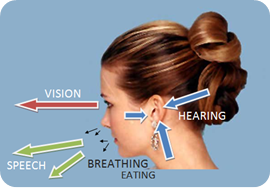
In the creation of the human, Allah intended the human head to be completely unobstructed in order for all the systems to function optimally. This is how:
The Eyes
Light rays from reflecting scenery are to fall on the eye through an unobstructed passage in order to perceive the true intensity and the colour of the scenery. A barrier would block light. This is an important reason why the eyes are on the head, since the head is expected to be left uncovered.
Mouth & Nose - Breathing
The exhaled breath contains a relative humidity of 100% - that is, it is highly moisture rich. This moisture as well as heat has to diffuse into the surrounding environment and not get trapped, if it does, then heat and moisture would cause discomfort on the skin. This is a reason why nose and mouth are again placed by Allah on the head, so that an unobstructed passage is maintained with the environment, allowing diffusion of heat and moisture optimally.
The Ears
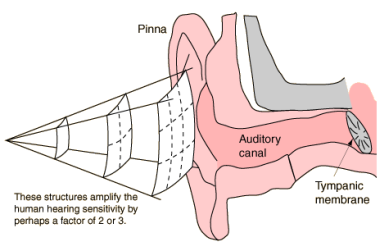
The pinna (outer ear) which is visible on every person is a special acoustic device. Its purpose is to gather sound waves, amplify and direct it to the eardrum (Tympanic membrane), as well as to help "localise" the sound that arrives there (to help determine the direction the sound is coming from). It is obviously intended to be in an unobstructed location. Its performance deteriorates when it is obstructed by anything - both localisation and amplification. Once again, this is why the ear is located along with the eyes, nose and mouth which require a clear passage to the surrounding to work optimally.

Allah placed the outer ear in such a
location so that it can be left unobstructed.
Obstructing it reduces the quality of its functioning.
Mouth & Nose - Speech
The voice box produces speech sound that emanates from the mouth. Not only does the mouth need to be exposed for adequate heat and moisture diffusion from breathing, vocal sound originating from there need an unobstructed path to reach the target without attenuating or sounding muffled to any degree, thus the location from which sound is produced is also on the head.
Eating
To eat, there cannot be an obstruction in front of the intake. Thus, the eating channel, the mouth, is located here along with the rest that need open space.
Imagine if our mouth and nose was placed on our chest which women do need to cover, it would be difficult to breath over the shirt / dress, difficult to eat, and our voice would sound not as clear as it does now!
Facial Expressions
 One amazing manifestation of Allah's
power is how He manages to place the sensors for all the above functions needed by the human, on the human head, yet make it a seamless work of perfect art. Not at all,
does one need to wonder that these are individual sensors, rather the whole face looks like beautiful continuous artwork.
One amazing manifestation of Allah's
power is how He manages to place the sensors for all the above functions needed by the human, on the human head, yet make it a seamless work of perfect art. Not at all,
does one need to wonder that these are individual sensors, rather the whole face looks like beautiful continuous artwork.
One of the most important features of the human head is this overall work of art: the face itself as an own entity. This work of art is designed to be a communications device. Underneath the face, lies hundreds of muscles which are capable of making countless expressions that convey the emotional state of the person. When speaking to a person, the human face continuously changes to convey important information such as acknowledgement of a message understood, confusion, happiness, distress and the like. Thus, the face is an important communications medium when speaking to someone, whether it be to a male or female. It is for this reason the human face serving this distinct purpose (yet consisting of eyes, mouth, nose and ears) is 'located' on the head. Because this way, not only are all sensory organs are free, so is the face. This again goes to proves that the human head, the entire head is designed and expected to be left uncovered in the blueprint, or master-plan of Allah. The hair is integral to this artwork, as we shall soon see how the appearance of a man's or a woman's hair is essential for basic human aesthetics.
Everything that has been said so far fully applies to both male and female, because the functions and systems of the head are identical in both men and women.
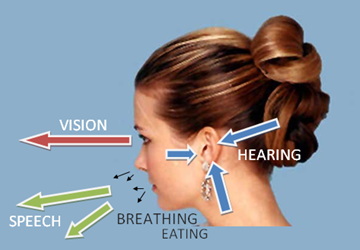
The eyes, nose, mouth and ears all require an exposed environment to work as designed, including the face, which is why Allah has placed them all on the head. This is why the head is 'designed' to be exposed and not covered. The functions are identical on both men and women, therefore women too require the head to always be free of obstruction.
Understanding the Quranic Verses
First of all, it must be understood on part of the thinking reader that the true religion of Allah is in full harmony with Allah's created mechanisms and intentions in nature.
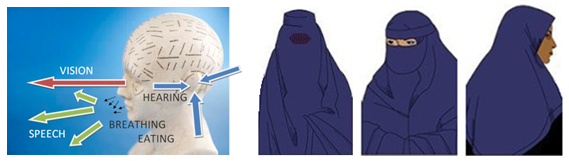
In order for something to be a Quranic commandment, the command has to be in harmony with the designed functions of the Creator's design.
Therefore, in order for a dress to be a command of Allah, the expected senses that require exposure at all times cannot be concealed. Note that they do not stop functioning outdoors, they are in continuous use. Therefore, the expectation that the head is a part of the body that remains always exposed in the blue-print or master-plan of Allah, is valid for all times of the day (indoor or outdoor).
Does the Qur'an command the covering of hair for women ("Hijab")?
The word "hijab" is never used in the Qur'an in the context of women's dress. This word is used only in its general meaning of "barrier" in other contexts (eg. 17:45), but never in women's dress or modesty. Yet it has developed completely unique applications among the majority. There is no use of the word 'hijab' in terms of women's dress in the Qur'an.
One part of a verse of the Qur'an has been attempted to be shown to command the covering of hair. This is the 31st verse of Surah An-Nur quoted as follows:
وَقُلْ
لِلْمُؤْمِنَاتِ يَغْضُضْنَ مِنْ أَبْصَارِهِنَّ وَيَحْفَظْنَ فُرُوجَهُنَّ
وَلا يُبْدِينَ زِينَتَهُنَّ إِلا مَا ظَهَرَ مِنْهَا وَلْيَضْرِبْنَ
بِخُمُرِهِنَّ عَلَى جُيُوبِهِنَّ
(Qur'an 24:31)
"Tell the believing women to lower their gaze and guard their private parts, and that they shall not flaunt their beauty except for what appears (naturally) from it, and let them put forth their covers over their cleavage." (Qur'an 24:31)
The portion used to mean cover the hair is the underlined portion above (وَلْيَضْرِبْنَ بِخُمُرِهِنَّ عَلَى جُيُوبِهِن َّ ). It should be understood that the ordainment, or the commandment here is for a believing woman to cover her cleavage. It is not commanding her to cover her hair. The word "hair" does not appear in the Arabic. The Arabic word translated as "covers" for the Arabic word خُمُرْ / 'khumur' (plural of 'khimar'), should be translated with due regards to several factors. These include:
(1) The logical understanding on the nature in which Allah created the human head (ears need unobstructed passage for optimal performance, and hair on head is part of "natural" human pleasantness that we cannot do without {more later}).
(2) The Arabic root for the word, shares meanings with more general "covering" or "concealment" and not just headscarf.
(3) The immediate context within the verse, which is ordering the covering of the cleavage only (عَلَى جُيُوبِهِنّ), with no mention of hair (indicating the ordainment is not in the type of apparatus used, but in the covering of low neck-line). Even if it means 'headscarves' worn at the time, the command is not in the type of clothing used to cover the cleavage (headscarf), but to cover the cleavage. The usage of the word is determined by the readily available method at that instance, variable by other means in other parts of the world, or by any means such as a higher neck dress.
(4) It can be observed that men tend to cover all their chest and women reduce their neck-line in society in order to show-off feminine grace. Therefore, in order to tackle the common habit, a commandment to cover the cleavage area is a strong logical reason for the verse than the hair.
Therefore, it makes perfect sense to conclude that the intention of "وَلْيَضْرِبْنَ بِخُمُرِهِنَّ عَلَى جُيُوبِهِن َّ / and let them put forth their covers over their cleavage" is to order believing women to ensure the cleavage area is covered and not the hair.
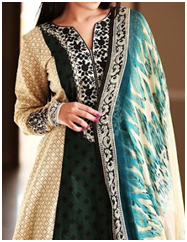
The Quranic requirement for 'khimar' requires a believer to wear an adequately high neckline dress (etc.) according to her conscience.
Further Point on the Nature of Hair
In the beginning, we saw how men and women have been given a common natural pleasantness as human beings:
"Children of Adam, take your adornment / pleasantness to every Mosque." (Qur'an 7:31)
Human hair on a woman is part of her natural 'human' aesthetics or pleasantness. Consider a bald woman, just how much this deteriorates her natural human aesthetics! Women's hair, therefore shares a function in common with men, by being part of a woman's natural human appearance and pleasant aesthetics.

This cancer patient demonstrates how loss of human hair on a woman deteriorates humanly pleasantness bestowed by Allah, proving that hair is an essential part of basic human aesthetics.
That is why, although Allah classes generally all of woman's body as "zeena" / beauty, the hair however, is considered to be in the Quranic 'exception' in verse 24:31, 'except for what appears naturally from the zeena/beauty', in the portion, "they shall not flaunt their zeena/beauty except for what appears (naturally) from it (the zeena/beauty) / َّ إِلا مَا ظَهَرَ مِنْهَا.
Obligating 'Hijab' and being Grateful to Allah for our Design
Let us elaborate this point further. Assume for argument's sake, God forbid, you were born with a genetic abnormality and could not grow hair on your head. Your appearance without your hair would be ugly. During your childhood, you probably had to wear hats outdoors out of shame. As an adult (assuming you do not already cover your head for religious reasons), if you have to walk outside, you would be compelled to cover your head. You may complain to Allah why He has not given you hair to cover this hideous appearance and regret being forced to substitute the blessing of hair with a hat or a scarf. Yet, without having to experience this shame, Allah mercifully blesses you with hair, which acts like a hat to cover your ugliness. To say you must cover that very blessing without which you would complain to Allah for is ungratefulness to Allah. Allah has kindly listened to your complaint without you even complaining - "He has given you all that you asked Him for." (Qur'an 14:34). Allah mercifully blesses you with hair so that you have the 'completed human look' to be able to walk outside without feeling shameful about your appearance.

Hair is part of basic human aesthetics. It constitutes the minimum look of a human being that allows people to function in society.
In addition however, believing women take pride in an
'additional' artistic design of Allah in which they have been created
(See
Women & Beauty - A Secret Revealed in the Qur'an).
Allah has designed women with a special gift in mind. He identifies this gift using the word 'zeena', a miraculous attribute that adds a unique beauty on top of the already pleasant human form common to a man. This is a general attribute in the design of the female body. Though women's hair is part of this 'zeena' / beauty gifted by Allah, it is part of which 'naturally appears' from a human and does not have to be covered. It is part of the exception in the following portion of the Quranic verse وَلا يُبْدِينَ زِينَتَهُنَّ إِلا مَا ظَهَرَ مِنْهَا , "they shall not flaunt their zeena/beauty 'except' for what (naturally) appears from it". The above fact of looking ugly and hideous without hair and that you would then be forced to cover your bald head to conceal this unsightfulness to function in society proves that hair is something which appears naturally on a human being, and thus part of the Quranic exception.
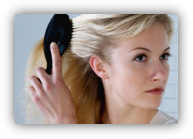
Your hair also performs the same function as a man's by giving you a humanly pleasantness. But its beauty as a woman can be seen by others, due to the part of the verse, "except for what appears (naturally) from the beauty".
The rest of Verse 24:31
Women have innumerable styles, attires, decorations and dresses available to them compared to the few bland styles of men due to their special gift of zeena / 'beauty'. In the rest of 24:31, Allah identifies a list of people where a believing woman may exceed in showing her beauty. However, how this is implemented outside or inside this group of people, such as which areas of the body are revealed, dresses, jewellery, cosmetics, and modes of behaviour suitable for any given moment is left entirely up to the conscience of the true believing woman. It may also vary between different believing women, according to their conscience and level of beauty, as well as specific or special situations. No other person has the right to define for a believing woman what the verse is telling her in terms of practical implementation.
A sincere believer's implementation is inherently correct, regardless of the views of others which depend on many influences and external agendas. No man or woman has the right to restrict or prohibit cosmetics / make-up, jewellery, dresses, sleeve-length, types of shoes etc. based on this verse or any verse, when Allah has intentionally left it open in the Qur'an for the believing woman's conscience.
"Do not say falsely, 'this is lawful (halal) and that is prohibited (haram)', inventing a lie about Allah. Those who invent lies about Allah do not prosper."
(Qur'an 16:116)
Exotic / Belly Dancing etc.
 Since earliest history, forms of exotic dances where the purpose is to stimulate erotic thoughts
have been famously and exclusively performed by women. For example, belly dancing, pole dancing, lap dancing etc.
Allah dignifies believing women by ensuring they are valued on similar terms with men by prohibiting such dances:
Since earliest history, forms of exotic dances where the purpose is to stimulate erotic thoughts
have been famously and exclusively performed by women. For example, belly dancing, pole dancing, lap dancing etc.
Allah dignifies believing women by ensuring they are valued on similar terms with men by prohibiting such dances:
"And they shall not stamp their feet in order to reveal parts of their beauty that should be hidden." (Qur'an 24:31)
However, artistic forms of dance, which do not sexually flaunt a woman's beauty is not part of the restriction as the verses uses an expression that indicates that only the more hidden part of the beauty should not be flaunted (مِنْ زِينَتِهِنَّ / min zeenatihinna) ie. sexual.
Does the Qur'an Command covering of the Face ("Niqab") ?
There is absolutely no indication of this in the Qur'an. It is obvious that such a command would conflict with the nature and intentions of the designs of the human head, and Allah's commandments are in harmony with His creation. Hearing, breathing, speech, eating and facial expressions, all have been designed and concentrated on the head so that it be left uncovered at all times - the head is designed intentionally to be exposed for all these systems to perform without deterioration. It is paramount to bear in mind once again, that Allah does not command against His purposes in design.
A verse used by some people, in an attempt to convince the face veil is 33:53, where believing men are told to speak to the prophet's wives from behind a 'barrier'. This verse has nothing to do with covering the face. See The Claim that Qur'an 33:53 Commands Women to Wear Niqab.
A Plea to Dress Modestly
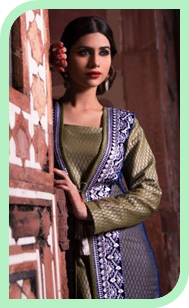
يَا أَيُّهَا النَّبِيُّ قُلْ لأَزْوَاجِكَ وَبَنَاتِكَ وَنِسَاءِ الْمُؤْمِنِينَ يُدْنِينَ عَلَيْهِنَّ مِنْ جَلابِيبِهِنَّ ذَلِكَ أَدْنَى أَنْ يُعْرَفْنَ فَلا يُؤْذَيْنَ وَكَانَ اللَّهُ غَفُورًا رَحِيمًا
"Prophet, tell your wives, your daughters, and women of the believers to bring near on them their garments. That is better so that they are seen [as modest], and so not be troubled/harmed. Allah has always been Forgiving, Merciful." (Qur'an 33:59)
The special gift of beauty to only womenkind means that it is difficult for men to dress provocatively, since they by design do not possess the unique beauty gifted to womenkind. For this reason, it is easy for women to dress provocatively. Verse 33:59 of the Qur'an is revealed to address just that. The emphasis here is not on what type of dress, but how modest the chosen dress should be.
By purely looking at the verse, "يُعْرَفْنَ / known as / seen as" achieves the meaning of being seen as modest women. Sectarians however, use "known as / seen as" to be more like 'identified' as "Muslim" woman, because they have defined a particular 'costume' / a 'uniform' for what a so-called Muslim woman should wear. The Qur'an does not define a costume, rather all cultural dresses of the world are acceptable. When the verse says "يُعْرَفْنَ / known as" or "seen as", it is inferring to be seen as simply modest (dignified) women because the part following it says "and so (فَلا) not be harmed/troubled." Therefore, it is not about marking out a believing woman as a subscriber to the religion using a unique costume. The dress of any culture if worn in this conscientious manner will satisfy the requirement of being seen as modest / dignified women.
This verse is in the context of being in public, as it talks about being "troubled/harmed".
Another related verse on the topic of 'Women & Beauty' is as follows:
[Wives of the Prophet]: "Settle in your homes - do not [go out] in order to make a flamboyant display of beauty like in the old times of ignorance." (Qur'an 33:33)
Note: The Wives of the Prophet (and all believing women) are permitted to go out, as the verse we have seen above (33:59), addresses 'how' they should go out i.e. be seen as dignified women.
Allah advises believing women to appear 'pleasant' when going out, when He says:
"Children of Adam, take your pleasant [appearances] to every Mosque."
(Qur'an 7:31)
Note: Here, "Children of Adam" includes both men and women.
Therefore to summarise, believing women do not go out with the intention of making a "flamboyant display of beauty" (33:33), yet dress 'pleasantly' outside (7:31) in the manner which does not bring 'harmful' attention (33:59) (the particularities of how is left to the conscience of the believing woman). Thus, we can conclude that the Qur'an preserves and honours the precious beauty of a woman's body gifted by Allah Himself. Also, the guidelines of Allah can be complied with while celebrating one's own cultural dress.
"Mankind, We created you from a single male and a female, and made you into nations and tribes, so that you may know (accept) one another. The most noble among you in the sight of Allah are those who are mindful of Allah. Allah is All-Knowledgeable, All-Wise". (Qur'an 49:13)
Note: The Arabic term in the first verse, "يُدْنِينَ عَلَيْهِنَّ / to bring near on them (their garments)", refers to the body naturally, rather than the head. It does not say, "over them" to indicate head-cover, but "on them" referring to the body i.e. wearing dress / clothing on the body. This is an oft-misunderstood or intentionally twisted part of the verse, as translating it as "over them" can imply head-covering.

Conclusion
The Qur'an reveals the secret of 'women and beauty', and asks believing women to honour this gift by dressing in a dignified and conscientious manner. People with ill intentions, who seek to find justifications for their personal cultures and agendas will go to any lengths to find a Quranic verse they can use to promote their prejudiced views. It is necessary for a true believer to remain sincere and objective, and use an unbiased approach to Allah's verses to dispel the myths. The above sorts of people depict a twisted view of religion and devotion to Allah, keeping people away from reading the Qur'an directly, thinking over it, and surrendering to Allah the true Quranic way.
Therefore to conclude, there is no requirement to cover the hair in the Qur'an for women. There is also no requirement for the face veil. The human head has eyes, mouth, nose and ears, all of which are designed to be left unobstructed at all times - i.e. the head is intended by Allah to be left uncovered, and the Qur'an remains in harmony with this.
Share this Article:

See also:
|
The Claim that Qur'an 33:53 Commands Women to Wear Niqab (Face Veil) |
|


Copyright © , QuranicPath. All Rights Reserved.