


FAQ - Women & Beauty: A Secret Revealed in the Qur'an
What is Women's Zeena?
Example:
 Belly dance
performances. This is a form of entertainment common in the Middle-east
region. It is entertaining to watch not just for men but also women. If
the female performer was replaced by a male, then, no matter how many
trinkets or props he wears, the performance will not be entertaining or
exciting to
watch {note}. Society terms women's good looks using terms such as "beautiful",
or "pretty". These terms are identical to the terms used to describe the
pleasant aesthetics of a flower, for example:
Belly dance
performances. This is a form of entertainment common in the Middle-east
region. It is entertaining to watch not just for men but also women. If
the female performer was replaced by a male, then, no matter how many
trinkets or props he wears, the performance will not be entertaining or
exciting to
watch {note}. Society terms women's good looks using terms such as "beautiful",
or "pretty". These terms are identical to the terms used to describe the
pleasant aesthetics of a flower, for example:
"A beautiful flower."
"A pretty flower."
instead of, "A handsome flower". A man is not described using the words "beautiful" or "pretty" either.
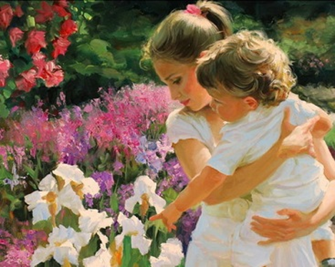
A girl is described as "beautiful", or "pretty", like the 'beauty' and 'prettiness' of flowers.
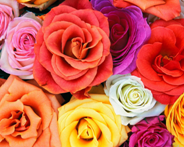
The beautiful colours and pretty designs of flowers are reflected in women's dresses, jewellery, shoes and hairclips etc. to compliment their physical attribute of the special beauty given by Allah. A flower in a man's hair looks odd, but looks 'beautiful' in a woman's and compliments her looks. The act of a man giving flowers to the woman he loves may be to show that she is as beautiful as the flowers he just gifted. Women's perfumes also try to smell of flowers such as roses. These societal habits are not merely coincidental, but as the very result of the truth of the Quranic secret revealed of women's beauty / zeena. This proves that the beauty of a woman is comparable with the delightful beauty we observe and enjoy in flowers, and it is specially employed by Allah in the design and creation of womankind.
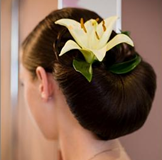
A beautiful flower on a woman compliments her looks / beauty (i.e. both are 'beautiful'),
but fails to connect with the aesthetics of a man.
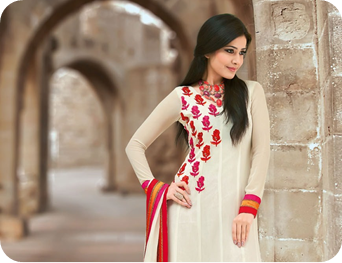
The beautiful designs of flowers as well as their colours used on women's dresses are very much to resemble the nature of the beauty bestowed by Allah to women - A beauty comparable to the beauty of flowers in nature. A wondrous miracle in the design and creation of the female body.
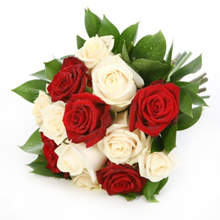
This very fact is testimony to the perfection of Paradise - described primarily in the Qur'an as Gardens. The beauty of the attendants therein match the beauty of the Gardens, just as they do in this world - men cannot be associated with the beauty of the Gardens of either worlds.
All Creatures have a Beautiful and Attractive Partner
It is revealed in the Glorious Qur'an that all creatures are made in pairs. We can observe that one of which always has a more beautiful nature. Sometimes, this beauty is very striking to human eyes, other times it is less striking. No doubt, it is always discernable to the creatures concerned. Sometimes, the role of the carrier of the special beauty is reversed. Among peacocks, it is the male who is the beautiful partner. Conversely, in humans, it is the female who is the beautiful partner.
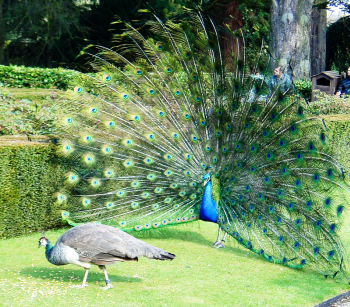
Among peacocks, it is the male which carries the special beauty, by which he attracts the female. Among humans, females carry the special beauty.

The female human is equivalent to the male peacock in nature. Clothing and decoration can accentuate her beauty, but not her partner's as he does not possess the special beauty.
What is apparent Zeena?
The Qur'an says believing women shall not flaunt their zeena except for what appears naturally. Therefore, although a woman's whole body is naturally zeena, it does not mean she has to cover all of it. For example, the head is part of zeena, but it does not mean it has to be covered.
It is up to the individual believer to use her conscience in what to wear / how to appear in accordance with the Qur'an - Allah does not wish to place any burden on her ("Allah does not wish to place any burden on you" - 5:6 ) and has left the instructions open for her personal implementation. Nobody has the right to impose limitations on the verses by telling her exactly how to dress, what is permitted or not, labelling items of clothing or cosmetics, "haram / halal".
"Do not say falsely. 'this is halal (lawful) and that is haram (prohibited)', inventing a lie about Allah. Those who invent lies about Allah do not prosper." (Qur'an 16:116)
Can men also be good-looking and be attractive?
Men can possess good-looks, however it does not come in the special aura gifted to women which the Qur'an identifies.
Why does the Qur'an encourage women to restrict showing off their Zeena?
There are many reasons to this. For example, in the society of disbelief, women attending job interviews often try to dress seductively to increase the chance of impressing the interviewer. However, a society where Quranic morality prevails, an environment is nurtured where a woman attending a job interview is judged purely based on her merits and qualifications for the job.
Allah gives some people more than others in blessings. To Allah, one is only superior by virtue of their faith and deeds and not by how much beauty He has given them. In order to nurture a society where women are valued only in terms of the criteria meaningful to Allah - the just criteria, as well as for their own security, Allah advises believing women to restrict showing-off the special beauty gifted to them.
Share this Article:

See also:
|
Does the Qur'an Prohibit Muslim Women from singing in Public as the Clergy teach us? |

Copyright © , QuranicPath. All Rights Reserved.